The Upper Manawatu (or Ahu-a-Turanga) Block, as surveyed by Stewart, consisted of 250,000 acres, extending from the Makerua Swamp in the south to the Umutoi and Apiti districts in the north. It included most of the land between the Oroua River in the west and the line of the Tararua and Ruahine Ranges in the east. The block was formally transferred to the Crown, for £12,000, on 23 July 1864, the Deed of Sale being signed by 143 members of the Rangitane tribe. The sale took place at Raukawa Pa, on the south bank of the Manawatu River, about three miles downstream from the present-day Ashhurst Bridge. Hirawanu, the Rangitane chief, made a voluntary present of a portion of the money to the Ngati Raukawa.
Following further surveys, the Wellington Provincial Government laid out the township of Palmerston in the Papaioea clearing on the northwestern bank of the Manawatu River in 1866. The district of Fitzherbert, on the eastern side of the river, was named after William (later Sir William) Fitzherbert, a prominent member of the Provincial Council and later a Superintendent of the province.
The formation of a special settlement in the Fitzherbert district was considered by the immigration and public works authorities as early as 1872, only six years after the first organised land sales and settlement in Palmerston North. However, the Fitzherbert district was heavily bushed and isolated by the river from the nearest source of supplies until the first bridge was built in 1877. Many of the blocks of land at Fitzherbert East, between the Tiritea Stream and the Manawatu Gorge, were sold during the period 1877-85.
Among the earliest settlers were J. R. Forster- Pratt, Alfred Stace, and Jens Christensen; other names include Bryant, Thomas Smith, Captain Walker, Mackie and Andrewartha. The families of R. Sadler Smith, W. S. Gawith, and S. Standen also settled during the 1880s.
An important influence in the development of Fitzherbert, and of the Manawatu generally, was the Wellington and Manawatu Railway Company, floated in 1881. The directors and major share-holders were prominent Wellington businessmen, many of whom had purchased blocks of land in the Manawatu. The railway between Wellington and Longburn was completed in 1886, opening up large tracts of the forested land from Levin through
Shannon, Tokomaru and Linton. Blocks of land at Fitzherbert East were offered for sale at auction on behalf of the Railway Company on 19 February 1885. Some of these blocks, particularly those on the steeper hill slopes furthest from the river, remained unsold and were offered again on 28 May 1889.
A subdivision of larger blocks at the top of the Pahiatua Track, constituting the Tararua Settlement, took place in the early 1900s (see Chapter 4). With the failure of this settlement, much of the land was acquired by the Hannah family. By 1919, they also owned the Siberia Estate (northeast of Forest Hill Road) and the Cliffside Estate (between Fitzherbert East Road and the Manawatu River, extending from Siberia to almost a mile south of Forest Hill
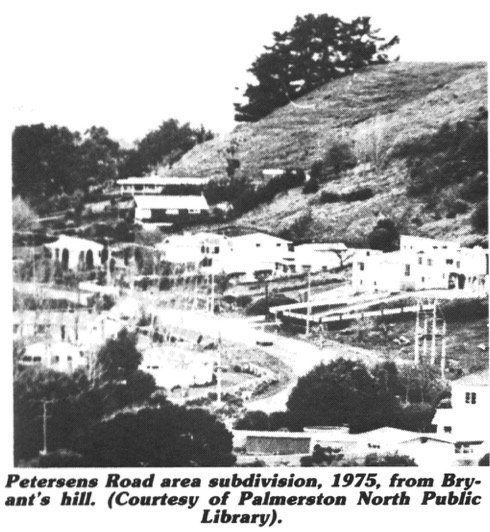
To ease the financial burden on the ratepayers of the area, the Council decided to allow the subdivision of a further seven sections from the V.J. Petersen property on the west side of the highway, increasing the number of allotments in the special rating area. (The result of this provision of a local sewerage scheme was to raise rates on the quarter-acre sections in the area from about £5 to £14 per annum, in 1965-66.) With the incorporation of the area within the city boundaries in 1967, the city took over responsibility for the scheme. By 1968, houses had been built on most of the sections, and the population of the "village" has since remained fairly steady at 65-75.