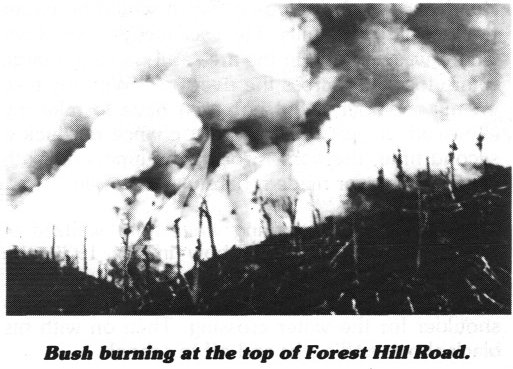
Burning of the bush was always preceded by comprehensive chopping of the under storey during the winter and spring. Usually anything less than three feet in diameter was axed. Larger trees were left in the expectation that they would die in the fire - most did, and often remained as gaunt, blackened skeletons for decades afterwards. On steep slopes, the "drive" was used to speed the task of bush felling: a big tree with a heavy spreading top was used to start a chain reaction, smashing down those lower down the slope.
Burning was generally carried out in March, filling the air with smoke for miles around. It was not uncommon for a burn to get out of control - the Tararua School at the top of the Pahiatua Track was twice destroyed by fire, in 1905 and 1917.
Effective as the burning may have been, it is now recognized that it would have been environmentally wiser to have left some large expanses of virgin bush, particularly on the steeper slopes and in the gullies that are now prone to slips and erosion.
Nevertheless, it was seen at the time as the only practical way of carrying out the large-scale clearance of the land for the development of the pastures that were to bring prosperity to the district in the years that followed.
After the burn, grass seed was sown before the ashes were blown away or washed off, and before weeds appeared. The seed recommended was called "Bushburn" and was a mixture of perennial rye, cocksfoot and rye plus lesser quantities of white clover, alsike, and timothy. Unfortunately, the seed used mostly had a predominance of short-term grasses, Italian rye, and red clover in it.
Although feed was obtained much more quickly from this mix, the grass soon died and weeds encroached. This caused problems that hill farmers are still having to cope with today.
Because there were tangled heaps of jagged logs left after the burn, sowing was a difficult job. The sower made an empty bag into a sort of waistcoat with two large pockets which held 30 to 40 pounds of seed. This was applied at the rate of 24 pounds per acre. Using both hands, throwing his arms wide alternately, the sower covered 10-15 feet in a strip.
Freshly shorn sheep were driven over the soil to press the seed in and then rain was awaited impatiently.
As stock got lost in the bush and were found starving, fencing had to be done. To encourage grass to root strongly, heavy concentration of stock, followed by closing up the paddocks, was needed. This rotational grazing made fencing essential. The fencing contract was usually for all stumps etc to be cleared from a twelve-foot wide path, with posts spaced no more than 16 feet apart.
Posts in dips had to hold the fence down with usually five battens to a panel. Wire and staples were bought but timber, most often totara, for posts, strainers and battens was available locally.
Fencers had to split the material, haul it to the line, erect it and strain the wires, generally seven in number. Whenever possible, fence lines were positioned on ridges, as on slopes, slips frequently wrecked new fences.
Over the years, improvements have occurred with gadgets such as wire strainers, post-hole diggers, and tanalized posts, and airlifting in of mass-produced, uniform-sized timbers. Steel wire 12½ gauge has replaced the No. 8 galvanised because more can be carried weight for weight.
Although decomposition has removed many of the totara timbers, the fence lines have remained.
In the early days, most farms had a cow or two for domestic use but the money earners were sheep, pigs and cattle. Milking was done in the open.
Milk was taken into the "dairy", poured into large flat round setting pans and left to cool. The cream was skimmed off by hand, using a metal skimmer, then it was churned by hand and the resultant butter fetched 3d or 4d a pound if bartered, but a writer states: "It was of wretched quality, variable